Family Life Is Where Social Belonging Often Begins

Long before we understand what community means, we learn it at home. The household – whatever shape it takes – is where most people first encounter care, responsibility and the unspoken rules of living alongside others.
No Single Blueprint
Across societies, family looks remarkably different. A grandmother raising grandchildren in Lagos, a single professional in Edinburgh sharing a flat with friends, a three-generation household in rural Japan – each arrangement carries its own emotional logic and daily rhythm. Home is not a fixed idea.
Routines That Shape Us
Shared mealtimes, bedtime rituals, who does the washing up – these small habits quietly build identity and expectation. Children absorb social norms through repetition, not instruction.
Care as a Shared Responsibility
Within households, care roles shift constantly. Parents become carers; adult children support ageing relatives. These relationships teach reciprocity in ways no classroom quite manages.
Neighbourhoods Turn Daily Routines Into Social Relationships
The walk to school, the queue at the corner shop, the nod exchanged at the bus stop – these small, repeated moments are where neighbourhood life actually happens. Familiarity builds quietly, through proximity and routine rather than any deliberate effort.
Everyday Routines and Repeated Encounters
Regularity creates recognition. When the same faces appear at the same times – the newsagent who knows your order, the parent you see every morning at the school gate – something like informal trust develops. It rarely becomes deep friendship, but it softens daily life considerably.
Shared Spaces and What They Make Possible
Parks, cafés and community centres give people reasons to occupy the same ground. A playground brings parents into conversation; a local library offers neutral territory. These spaces don't manufacture community, but they give it somewhere to breathe.
When Surroundings Shape Who Connects
Access matters. Poor street lighting, unreliable transport or overcrowded housing can quietly cut people off from the social fabric that others take for granted. Belonging isn't evenly distributed across a postcode.
Communities Create Memory, Meaning and Mutual Responsibility
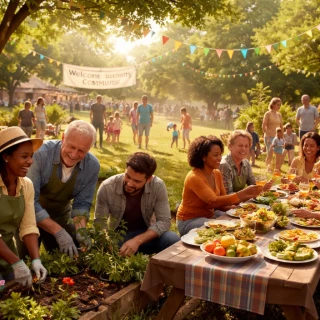
Shared life beyond the front door shapes who we are just as much as what happens inside it.
The Bonds That Belonging Builds
There's no denying that a sense of belonging does something measurable to people. Research from the British Red Cross found that over nine million adults in the UK often or always feel lonely – yet those embedded in active local communities report stronger mental health and greater resilience. Belonging isn't passive. It grows through repetition: the same neighbours at the school gate, the annual bonfire, the community garden that nobody planned but everyone tends.
Shared Memory as Social Glue
Collective experiences – a local flood, a street party, a decades-old carnival – become the stories communities tell about themselves. These shared memories anchor identity to place.
Responsibility Runs Both Ways
Individuals shape communities through volunteering, showing up, and simply noticing others. Communities, in return, hold people through difficulty.
Strong Communities Help Everyday Life Feel More Human
Belonging rarely arrives all at once. It builds quietly – through a neighbour who remembers your name, a street where children still play outside, a community hall that hosts the same harvest fair it has for forty years. Family structures give people their earliest sense of place and identity, while neighbourhood ties and shared routines extend that feeling outward into something larger. When these layers work together – close relationships, familiar spaces, collective memory – they create the kind of meaning that no individual can manufacture alone. There's no denying that places feel most like home when people feel genuinely seen within them. Noticing those connections, and choosing to tend them, matters more than most of us realise.